
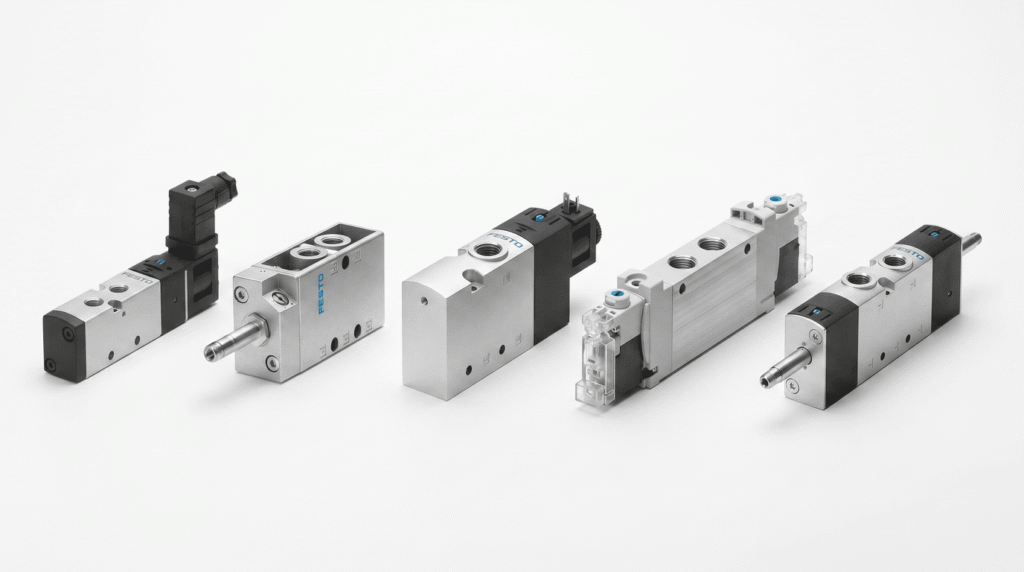
Festo Solenoid Valves
Festo solenoid valves are electrically controlled pneumatic valves used to manage compressed air flow in industrial automation systems. These valves control the movement of pneumatic cylinders and actuators by starting, stopping, or changing the direction of airflow based on electrical signals from machines, controllers, or automation systems.
In modern industries, Festo solenoid valves play an important role in improving machine speed, accuracy, reliability, and automation efficiency. Selecting the right solenoid valve depends on factors such as valve type, airflow requirement, operating pressure, voltage, response time, and application conditions.
Festo offers different pneumatic valve solutions including VUVG valves, CPE valves, directional control valves, and valve terminals for various industrial applications.
Krish Engineering supplies genuine Festo solenoid valves and provides technical support for valve selection, replacement identification, and complete pneumatic automation solutions.
What Are Festo Solenoid Valves?
Festo solenoid valves are electromechanical pneumatic control devices that use an electrical signal to control compressed air movement inside a pneumatic system. They act as the connection between the electrical control system and pneumatic components.
Simply explained:
The electrical system gives a command, the solenoid valve controls compressed air, and the pneumatic actuator performs the required movement.
For example:
In an automated packaging machine:
- A sensor detects product position
- Controller sends an electrical signal
- Festo solenoid valve switches airflow
- Pneumatic cylinder moves
- Machine operation is completed
This combination of electrical control and pneumatic power makes solenoid valves essential components in industrial automation.
Festo solenoid valves are commonly used for:
- Starting airflow
- Stopping airflow
- Changing airflow direction
- Controlling pneumatic cylinder movement
- Operating automation sequences
They are widely installed in:
- Manufacturing machines
- Packaging equipment
- Assembly lines
- Textile machinery
- OEM automation systems
Main Components of a Festo Solenoid Valve
A Festo solenoid valve contains several important components that work together to provide accurate pneumatic control.
Understanding these parts helps engineers select, troubleshoot, and maintain valves properly.
The valve body is the main structure of the solenoid valve.
It contains internal air passages that allow compressed air to move between different ports.
The valve body controls:
- Air entry
- Air direction
- Exhaust flow
- Pressure movement
A properly designed valve body ensures efficient airflow and reliable machine operation.
The size and design of the valve body affect:
- Flow capacity
- Response speed
- Pressure handling
Solenoid Coil
The solenoid coil is the electrical operating part of the valve.
It converts electrical energy into magnetic force.
When voltage is supplied to the coil:
- The coil becomes energized
- A magnetic field is created
- The internal valve mechanism moves
- Air direction changes
Common coil voltage options include:
· 24V DC
· AC voltage options depending on machine requirements
Selecting the correct coil voltage is important because incorrect voltage can cause:
- Coil failure
- Overheating
- Valve malfunction
Spool Mechanism
The spool mechanism controls the internal switching of compressed air.
When the solenoid activates, the spool changes position and redirects airflow through different ports.
The spool determines:
- Which direction air flows
- When the actuator moves
- How the cylinder operates
Smooth spool movement is important for accurate and fast pneumatic control.
Problems such as dust, moisture, or contamination can affect spool movement and cause valve failure.
Ports and Connections
Solenoid valves contain multiple ports for compressed air movement.
Common ports include:
Pressure Port
This is where compressed air enters the valve.
Working Ports
These ports send air to pneumatic cylinders or actuators.
Exhaust Ports
These allow used compressed air to exit the system.
Correct connection of ports is necessary for proper machine operation.
Wrong connections may cause:
- Incorrect cylinder movement
- Slow operation
- System malfunction
Manual Override
Manual override allows operators or maintenance engineers to activate the valve manually without an electrical signal.
It is useful during:
- Machine testing
- Maintenance work
- Troubleshooting
- Installation checking
Manual override helps identify whether a problem is related to:
- Electrical control
- Air supply
- Valve operation
How Do Festo Solenoid Valves Work?
Festo solenoid valves work by using an electrical signal to move an internal valve mechanism, which controls the direction of compressed air. This controlled airflow operates pneumatic cylinders and other pneumatic actuators in automation systems.
The working process happens in four main steps.
Step 1: Electrical Signal Activates the Solenoid Coil
The process starts when a machine controller sends an electrical signal to the valve coil.
The signal may come from:
- PLC systems
- Sensors
- Control panels
- Automation controllers
When the coil receives voltage, it becomes energized and prepares the valve for switching.
Step 2: Magnetic Field Moves the Valve Mechanism
After the solenoid coil is energized, it produces a magnetic field.
This magnetic force moves the internal mechanism of the valve.
Depending on the valve design, it changes the airflow path inside the valve body.
This allows the valve to control compressed air movement automatically.
Step 3: Compressed Air Direction Changes
Once the valve switches position, compressed air is redirected.
The valve decides:
- Where air should enter
- Which actuator chamber receives pressure
- Where exhaust air should leave
This airflow control creates controlled pneumatic movement.
Step 4: Pneumatic Actuator Movement Happens
After compressed air reaches the actuator, mechanical movement occurs.
For example:
In a double acting pneumatic cylinder:
- Air entering one side extends the cylinder
- Air entering the opposite side retracts the cylinder
The solenoid valve controls this movement repeatedly during machine operation.
Supporting Components Used With Festo Solenoid Valves
A complete pneumatic automation system requires multiple components working together.
Important supporting components include:
Pneumatic Cylinders
Festo solenoid valves are commonly used with Festo Pneumatic Cylinders
The valve controls:
- Extension movement
- Retraction movement
- Speed timing
FRL Units
FRL units prepare compressed air before it reaches pneumatic components.
They help:
- Remove contamination
- Control pressure
- Improve component life
Clean compressed air improves valve reliability.
PU Tubes and Fittings
PU tubes and pneumatic fittings transfer compressed air between components.
Correct sizing helps maintain:
- Proper airflow
- Stable pressure
- Machine efficiency
Sensors
Sensors provide feedback to automation systems.
They help control:
- Position detection
- Operation timing
- Machine sequencing
Types of Festo Solenoid Valves
Festo provides different solenoid valve types for different pneumatic automation requirements.
The correct valve selection depends on:
- Application type
- Required airflow
- Cylinder size
- Operating pressure
- Machine speed
- Control method
Choosing the right Festo pneumatic valve improves machine performance and reduces downtime.
Festo VUVG Solenoid Valves
Festo VUVG solenoid valves are compact pneumatic valves designed for high-performance automation applications where space saving and fast switching are important.
They provide efficient airflow control in a compact design.
Features of Festo VUVG Valves
Key features include:
- Compact construction
- Fast response
- Reliable switching
- Efficient pneumatic control
Because of their small size, they are suitable for machines where installation space is limited.
Applications of Festo VUVG Valves
Common applications include:
Packaging Machines
Used for:
- Fast cylinder movement
- Product handling
- Repetitive automation cycles
Assembly Systems
Used for:
- Component positioning
- Pick and place operations
- Automated movement
Compact Automation
Ideal where machine designers need reliable pneumatic control in limited space.
Festo CPE Solenoid Valves
Festo CPE solenoid valves are designed for reliable pneumatic control in industrial machines. They are commonly used where durability and consistent operation are required.
Features of Festo CPE Valves
Benefits include:
- Reliable performance
- Industrial design
- Stable airflow control
- Long service capability
Applications of Festo CPE Valves
CPE valves are commonly used in:
- Manufacturing equipment
- Production machines
- Automation systems
- Industrial machinery
They are suitable for applications requiring dependable pneumatic operation.
Festo MFH Solenoid Valves
Festo MFH solenoid valves are widely used for industrial pneumatic control applications. They provide dependable switching performance for machine operation.
Features of Festo MFH Valves
Advantages include:
- Strong construction
- Reliable operation
- Suitable for industrial environments
Applications of MFH Valves
Used in:
- Machine automation
- Pneumatic cylinder control
- Manufacturing processes
MFH valves are selected when reliable airflow switching is required.
Festo Directional Control Valves
Festo directional control valves manage the direction of compressed air flow inside pneumatic systems. They determine how pneumatic actuators move.
The most common directional valve types are:
3/2 Directional Control Valves
A 3/2 valve has:
- 3 ports
- 2 positions
Commonly used for:
- Single acting cylinders
- Simple pneumatic operations
- Air signal control
5/2 Directional Control Valves
A 5/2 valve has:
- 5 ports
- 2 positions
Commonly used for:
- Double acting cylinders
- Forward and return movement
They are one of the most common valve types in industrial automation.
5/3 Directional Control Valves
A 5/3 valve has:
- 5 ports
- 3 positions
Used when applications require additional control positions.
Applications include:
- Advanced cylinder control
- Specific stopping conditions
- Special automation requirements
Festo Valve Terminals
Festo valve terminals combine multiple pneumatic valves into one organized control system.
Instead of installing many individual valves separately, industries use valve terminals for centralized pneumatic control.
Benefits of Festo Valve Terminals
Advantages include:
- Reduced installation space
- Easier wiring
- Organized pneumatic control
- Faster maintenance
- Multiple actuator operation
Applications of Valve Terminals
Used in:
- Large automation systems
- Packaging lines
- Assembly machines
- Multiple cylinder control systems
Valve terminals improve efficiency in complex industrial machines.
Festo Solenoid Valve Types Comparison Table
| Festo Valve Type | Best For | Common Applications |
| VUVG Valve | Compact high-speed automation | Packaging machines, assembly systems |
| CPE Valve | General industrial automation | Manufacturing equipment |
| MFH Valve | Reliable pneumatic control | Industrial machines |
| Directional Control Valve | Cylinder movement control | Pneumatic actuators |
| Valve Terminal | Multiple actuator control | Large automation systems |
How to Choose the Right Festo Solenoid Valve
Selecting the correct Festo solenoid valve ensures smooth machine operation, better response time, and longer pneumatic system life.
Important selection factors include:
Valve Size and Flow Rate Selection
Valve size affects how much compressed air can pass through the valve.
Flow requirement depends on:
- Cylinder size
- Cylinder speed
- Machine cycle time
- Air consumption
A valve that is too small can restrict airflow and slow cylinder movement.
A correctly sized valve improves performance and efficiency.
Number of Ports and Positions
Different applications require different valve configurations.
Selection depends on actuator operation.
Use:
- 3/2 valves for simple control applications
- 5/2 valves for double acting cylinders
- 5/3 valves when intermediate control is required
Operating Voltage Selection
Voltage selection must match the machine control system.
Common options include:
- 24V DC systems
- AC voltage systems
Wrong voltage selection may damage the solenoid coil.
Always check machine requirements before replacement.
Pressure Requirements
Every pneumatic system operates within a specific pressure range.
Correct pressure ensures:
- Proper airflow
- Stable actuator movement
- Reliable operation
Insufficient pressure can cause slow or incomplete machine movement.
Response Time Requirements
High-speed machines require fast valve response.
Response time is important in:
- Packaging equipment
- Sorting machines
- High-cycle automation
Fast switching improves productivity.
Working Environment Conditions
Industrial environments affect valve performance.
Consider:
- Dust exposure
- Moisture
- Temperature
- Continuous operation
Choosing the correct Festo valve based on working conditions improves reliability and reduces downtime.
Festo Solenoid Valve Selection by Application
Festo solenoid valve selection depends on the machine application, pneumatic actuator requirement, operating conditions, and automation control method. Choosing the correct valve improves machine speed, reduces downtime, and ensures reliable compressed air control.
Different industrial applications require different Festo pneumatic valves because every machine has unique airflow, response time, pressure, and control requirements.
| Application | Recommended Festo Valve |
| Compact automation machines | Festo VUVG solenoid valves |
| General industrial automation | Festo CPE solenoid valves |
| Heavy machine operation | Festo MFH solenoid valves |
| Pneumatic cylinder control | Festo directional control valves |
| Multiple actuator control | Festo valve terminals |
Correct valve selection helps industries achieve better productivity, accurate actuator movement, and longer pneumatic system life.
Replacing Old or Obsolete Festo Solenoid Valves
Many industrial machines operate for several years, and over time solenoid valves may require replacement due to wear, electrical failure, machine upgrades, or discontinued valve models.
Replacing a Festo solenoid valve is not only about matching the physical appearance. The replacement valve must match the pneumatic function, electrical specifications, airflow capacity, and machine requirements.
Many maintenance engineers face problems such as:
- Old Festo valve model number missing
- Product label damaged
- Existing valve series discontinued
- Machine documentation unavailable
- Difficulty finding exact replacement
In these situations, proper technical identification is required before replacing the valve.
How to Identify an Old Festo Solenoid Valve Replacement
Selecting the correct replacement valve requires checking several important details.
Existing Model Number
The model number is the easiest way to identify the correct Festo valve replacement.
It provides information about:
- Valve series
- Valve type
- Function
- Technical specifications
However, in many old machines, labels become unreadable due to:
- Oil exposure
- Dust
- Machine heat
- Long operating periods
When the model number is unavailable, other specifications should be checked.
Operating Voltage
The replacement solenoid valve must match the machine electrical system.
Common voltage options include:
- 24V DC
- AC voltage variants
Using an incorrect voltage can cause:
- Coil damage
- Overheating
- Valve failure
Number of Ports and Positions
Valve function must match the existing pneumatic circuit.
Check whether the valve is:
- 3/2 way valve
- 5/2 way valve
- 5/3 way valve
Incorrect selection can change actuator movement and affect machine operation.
Flow Requirement
Flow capacity determines how much compressed air passes through the valve.
The correct flow rate ensures:
- Proper cylinder speed
- Smooth movement
- Correct machine cycle timing
Mounting Style
Replacement valves should match the installation arrangement.
Check:
- · Individual valve mounting
- · Manifold mounting
- · Valve terminal arrangement
Application Conditions
Before replacing a valve, consider:
- Machine operation frequency
- Working pressure
- Environment
- Required response speed
Krish Engineering helps industries identify old Festo solenoid valves, compare technical specifications, and suggest suitable replacement solutions without affecting machine performance.
Common Festo Solenoid Valve Problems and Solutions
Festo solenoid valves are designed for reliable pneumatic automation. However, continuous industrial usage, contamination, incorrect installation, or poor air quality can create operational issues.
Understanding common problems helps maintenance teams reduce downtime and unnecessary replacement costs.
Solenoid Valve Not Operating
A solenoid valve not switching is one of the most common issues in pneumatic systems.
When the valve does not operate, the pneumatic cylinder or actuator may stop moving.
Possible Causes
Coil Failure
The solenoid coil may fail because of:
- Incorrect voltageElectrical problems
- Overheating
- Long operating cycles
A damaged coil cannot generate the magnetic force required to operate the valve.
No Electrical Signal
The valve requires a proper electrical signal for operation.
Problems may occur due to:
- Wiring issues
- PLC output problems
- Loose connections
Mechanical Sticking
Internal valve movement may become restricted due to:
- Dust particles
- Moisture
- Contamination
Solutions
Check:
- Power supply
- Coil condition
- Electrical connections
- Air supply
- Valve operation
Proper troubleshooting helps identify whether the issue is electrical or pneumatic.
Air Leakage in Festo Solenoid Valves
Air leakage reduces pneumatic efficiency and increases compressed air consumption.
A leaking valve can affect:
- Cylinder force
- Machine speed
- Energy efficiency
- Production reliability
Causes of Valve Air Leakage
Seal Damage
Internal seals prevent unwanted air escape.
Continuous operation can cause seal wear over time.
Air Contamination
Poor compressed air quality allows:
- Dust particles
- Moisture
- Oil contamination
to enter the valve.
This can damage internal components.
Internal Wear
Long-term operation can naturally wear moving parts inside the valve.
Solutions
To reduce leakage:
- Maintain clean compressed air
- Use proper FRL units
- Inspect valve condition
- Replace damaged components
Festo Solenoid Valve Sticking Problem
Valve sticking happens when the internal mechanism does not move smoothly.
This affects airflow switching and machine operation.
Causes of Valve Sticking
Common reasons include:
- Dust accumulation
- Moisture inside compressed air
- Poor filtration
- Long idle periods
Solutions
Prevent sticking by:
- Maintaining air quality
- Removing moisture
- Checking FRL units
- Performing regular maintenance
Clean compressed air is one of the most important factors for long solenoid valve life.
Slow Pneumatic Cylinder Movement Due to Valve Problems
Sometimes the pneumatic cylinder is working but moves slower than expected.
The solenoid valve can be one of the causes.
Possible Reasons
- Incorrect valve size
- Restricted airflow
- Low pressure
- Blocked ports
- Flow control issues
Solutions
Check:
- Valve flow capacity
- Air pressure
- Tube connections
- Flow settings
Selecting the correct Festo valve ensures proper actuator speed and performance.
Festo Solenoid Valve Coils and Spare Parts
Festo solenoid valve spare parts help maintain pneumatic systems and reduce unnecessary replacement costs.
In many cases, a complete valve replacement may not be required.
Components such as coils and accessories can help restore operation depending on the problem.
Festo Solenoid Valve Coil Replacement
The solenoid coil is responsible for electrical activation of the valve.
A coil replacement may be required when:
- Valve receives power but does not switch
- Coil is burnt
- Coil overheats
- Electrical resistance changes
Correct coil selection depends on:
- Valve model
- Voltage
- Coil type
Using the correct replacement coil ensures safe and reliable operation.
Solenoid Valve Repair vs Replacement
Not every valve problem requires complete replacement.
The decision depends on the valve condition.
| Valve Condition | Recommended Solution |
| Coil failure | Replace coil |
| Minor contamination | Clean and inspect |
| Seal problem | Check spare availability |
| Internal damage | Replace valve |
| Obsolete model | Find updated replacement |
Proper diagnosis helps reduce maintenance costs.
How to Increase Festo Solenoid Valve Life
Proper installation and maintenance improve solenoid valve performance and reliability.
Industries can increase valve life by following good pneumatic practices.
Use Proper FRL Units
FRL units protect pneumatic components by improving compressed air quality.
They help:
- Remove dust particles
- Control air pressure
- Protect internal components
Clean air reduces valve problems.
Maintain Clean Compressed Air
Contaminated compressed air is a major reason for pneumatic valve failure.
Avoid:
- Water moisture
- Dust particles
- Oil contamination
Good air quality improves:
- Valve switching
- Seal life
- System reliability
Maintain Correct Voltage Supply
Incorrect voltage affects solenoid coil performance.
Always ensure:
- Correct voltage rating
- Stable electrical supply
- Proper wiring
Regular Inspection
Preventive maintenance reduces unexpected machine breakdowns.
Inspect:
- Air leakage
- Electrical connections
- Valve response
- Pneumatic fittings
Proper Installation
Correct installation prevents operational problems.
Check:
- Valve mounting
- Port connections
- Tube sizing
- Air direction
Industries Using Festo Solenoid Valves
Festo solenoid valves are used in different industries where reliable pneumatic control and automation are required.
Packaging Industry
Packaging machines require fast and repeatable pneumatic movement.
Festo valves control:
- Pneumatic cylinders
- Product handling systems
- Sealing mechanisms
- Sorting equipment
Fast response improves production efficiency.
Textile Machinery
Textile machines use pneumatic valves for:
- Fabric handling
- Machine movement
- Process automation
Reliable valve performance helps maintain continuous operation.
Automotive Manufacturing
Automotive industries use Festo pneumatic valves for:
- Assembly equipment
- Component handling
- Production automation
Accuracy and reliability are important in automotive manufacturing systems.
Food Processing Machines
Food processing equipment uses pneumatic automation for:
- Product movement
- Packaging
- Processing operations
Reliable pneumatic components help maintain smooth production.
Assembly Automation
Assembly systems depend on solenoid valves for:
- Pick and place movement
- Clamping
- Positioning
- Automated sequences
OEM Machine Manufacturing
OEM machine builders use Festo valves because they require:
- Flexible solutions
- Reliable components
- Compact designs
- Automation compatibility
Related Festo Pneumatic Products
Complete pneumatic automation systems require multiple components working together. Krish Engineering also supplies:
- Festo Pneumatic Cylinders
- Festo FRL Units
- Festo Sensors
- Festo Pneumatic Fittings
- Festo PU Tubes
- Authorized Festo Dealer in Madurai
These products support complete industrial pneumatic solutions.
Why Buy Festo Solenoid Valves from Krish Engineering?
Krish Engineering is an Authorized Festo Dealer in Madurai, supplying genuine Festo pneumatic products including solenoid valves, pneumatic cylinders, FRL units, sensors, fittings, and automation components with technical support and replacement assistance.
Genuine Festo Products
We supply original Festo solenoid valves and pneumatic components for industrial requirements.
Authorized Festo Dealer Support
Customers receive reliable product sourcing and technical assistance.
Festo Valve Identification Support
We help identify:
- Existing valve models
- Old valves
- Replacement products
- Alternative solutions
Old Valve Replacement Assistance
For discontinued or unavailable models, we help find suitable replacements based on:
- Valve function
- Voltage
- Flow requirement
- Application
Technical Product Guidance
Support includes:
- Valve selection
- Application matching
- Pneumatic troubleshooting
- Replacement identification
Ready Stock Availability
Fast product availability helps reduce machine downtime.
Fast Delivery Support
Quick supply helps maintenance teams and industries continue production smoothly.
Frequently Asked Questions About Festo Solenoid Valves
1. What are Festo solenoid valves used for?
Festo solenoid valves are used to control compressed air flow in pneumatic automation systems. They operate pneumatic cylinders, actuators, and industrial machine movements.
2. How does a Festo solenoid valve work?
A Festo solenoid valve works by converting an electrical signal into pneumatic control. The solenoid coil activates the valve mechanism, which changes compressed air direction.
3. Which Festo solenoid valve is best for automation?
The best valve depends on the application. VUVG valves are suitable for compact automation, CPE valves for industrial applications, and valve terminals for multiple actuator systems.
4. What is the difference between VUVG and CPE valves?
VUVG valves are compact and designed for space-saving applications, while CPE valves are commonly used for general industrial pneumatic control.
5. How do I select the correct Festo solenoid valve?
Selection depends on valve type, flow requirement, voltage, operating pressure, number of ports, response time, and application conditions.
6. What is the difference between 3/2 and 5/2 valves?
A 3/2 valve is commonly used for single acting cylinders, while a 5/2 valve controls double acting cylinders requiring forward and return movement.
7. How can I replace an old Festo valve?
Check the model number, voltage, port configuration, valve function, flow capacity, and mounting style to identify a suitable replacement.
8. What causes solenoid valve failure?
Common causes include coil failure, contamination, incorrect voltage, poor compressed air quality, and internal wear.
9. Can Festo solenoid valve coils be replaced?
Yes. Many Festo valve coils can be replaced depending on the valve model and condition.
10. Why does a solenoid valve leak air?
Air leakage usually happens due to worn seals, contamination, damaged components, or internal wear.
11. How do I identify an old Festo valve?
Old valves can be identified by checking model numbers, valve specifications, voltage, port configuration, and application details.
12. Where can I buy genuine Festo solenoid valves?
You can contact Krish Engineering for genuine Festo solenoid valves, technical support, and industrial pneumatic solutions.
13. Does Krish Engineering help with Festo valve replacement?
Yes. Krish Engineering helps identify old Festo valves, suggest replacements, and provide technical guidance for pneumatic applications.
14. Do you keep ready stock of Festo solenoid valves?
Yes. Krish Engineering maintains ready stock of commonly used Festo solenoid valves to support urgent industrial maintenance and automation requirements. Stock availability depends on the valve series, model number, voltage, and specifications. We also help source required Festo valves based on customer applications.
15. Do you supply Festo solenoid valves for industries and OEM machine manufacturers?
Yes. Krish Engineering supplies genuine Festo solenoid valves for industries, OEM machine manufacturers, automation companies, and maintenance requirements. We provide support for product selection, replacement identification, technical guidance, and regular industrial supply needs.
Need Help Selecting the Right Festo Solenoid Valve?
Selecting the correct solenoid valve improves machine reliability, automation efficiency, and pneumatic system performance.
Contact Krish Engineering for genuine Festo solenoid valves, product identification, replacement support, pricing assistance, availability, and complete industrial pneumatic solutions.