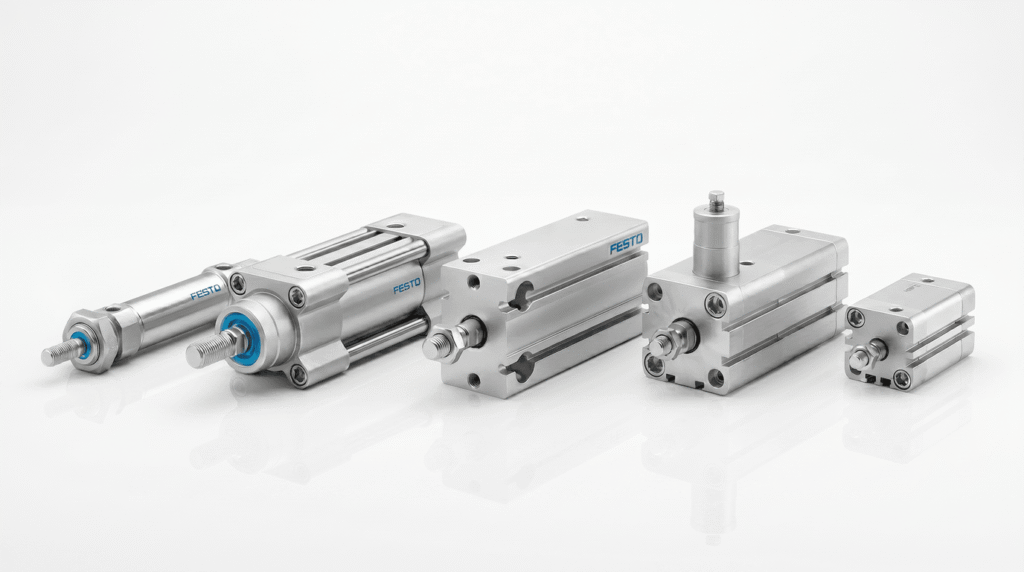
Festo Pneumatic Cylinders
Festo pneumatic cylinders are high-quality pneumatic actuators used to convert compressed air energy into controlled linear motion for industrial automation applications. These cylinders help machines perform pushing, pulling, lifting, clamping, and positioning operations with speed, accuracy, and reliability.
Selecting the right Festo pneumatic cylinder depends on important factors such as cylinder type, bore size, stroke length, operating pressure, mounting method, load requirement, and working environment. The correct cylinder selection improves machine performance, reduces downtime, and increases the life of pneumatic systems.
Industries use Festo cylinders in packaging machines, textile machinery, manufacturing equipment, assembly lines, automotive systems, and OEM automation machines because of their reliable performance and wide range of cylinder options.
Krish Engineering supplies genuine Festo pneumatic cylinders and provides technical support for cylinder selection, product identification, and industrial automation requirements.
What Are Festo Pneumatic Cylinders?
Festo pneumatic cylinders are compressed air-operated mechanical devices that create straight-line movement in machines. They are also known as pneumatic actuators because they convert air pressure into mechanical force.
In industrial automation, many machines require repeated movement. Instead of manual operation, pneumatic cylinders perform these movements automatically using compressed air.
A pneumatic cylinder is commonly used for:
- Moving machine parts
- Pushing products
- Pulling components
- Lifting materials
- Holding or clamping objects
- Positioning parts during manufacturing
The simple design, fast movement, and reliable operation make pneumatic cylinders one of the most commonly used components in automation systems.
A typical Festo pneumatic cylinder consists of several important parts:
Cylinder Barrel
The cylinder barrel is the main body where piston movement takes place. It provides the internal space where compressed air creates motion.
Piston
The piston separates the internal chambers of the cylinder. When compressed air enters the cylinder, pressure acts on the piston surface and creates movement.
Piston Rod
The piston rod transfers the movement from inside the cylinder to the outside machine mechanism.
It performs the actual pushing or pulling action required by the application.
Cylinder Seals
Seals prevent compressed air leakage and maintain proper pressure inside the cylinder.
Good sealing improves:
- Cylinder efficiency
- Force output
- Operating life
End Covers and Air Ports
End covers close the cylinder body, while air ports allow compressed air to enter and exit.
Together, these components help Festo pneumatic cylinders deliver accurate and repeatable motion in industrial machines.
How Do Festo Pneumatic Cylinders Work?
Festo pneumatic cylinders work by using compressed air pressure to move a piston inside the cylinder body. This piston movement creates linear mechanical motion used for industrial automation tasks.
The working process is simple:
Step 1: Compressed Air Enters the Cylinder
Compressed air from the pneumatic system enters through the cylinder port.
The air supply is usually controlled through:
- Solenoid valves
- Directional control valves
- Pneumatic control systems
Step 2: Air Pressure Moves the Piston
The compressed air applies force on the piston surface.
The amount of force depends mainly on:
- Bore size
- Air pressure
- Cylinder design
Higher pressure or larger bore size creates greater output force.
Step 3: Piston Rod Creates Linear Motion
As the piston moves, the piston rod extends or retracts.
This movement is used for machine operations such as:
- Pressing
- Pushing
- Pulling
- Sorting
- Transferring
Step 4: Direction Is Controlled
The direction of cylinder movement is controlled by pneumatic valves.
For example:
A double acting cylinder uses compressed air for both forward and return movement.
This provides better speed control and repeatable operation in automation systems.
Supporting Pneumatic Components
A complete pneumatic system also uses:
- FRL units
- Solenoid valves
- PU tubes
- Pneumatic fittings
- Sensors
These components help maintain clean air supply, accurate control, and reliable cylinder performance.
Types of Festo Pneumatic Cylinders
Festo offers different pneumatic cylinder types designed for various industrial requirements.
Selecting the correct cylinder type depends on:
- Machine design
- Available space
- Required force
- Stroke length
- Accuracy requirement
- Application environment
The most commonly used Festo pneumatic cylinders include:
Festo DSBC Standard Cylinders
Festo DSBC cylinders are standard profile pneumatic cylinders designed for reliable operation in industrial automation applications.
They are widely used where machines require strong, continuous, and accurate linear movement.
DSBC cylinders are suitable for applications requiring:
- Higher force output
- Stable movement
- Long operating life
- Industrial durability
Applications of Festo DSBC Cylinders
Common applications include:
Packaging Machinery
Packaging machines use DSBC cylinders for:
- Product movement
- Sealing operations
- Position control
- Material handling
Manufacturing Equipment
Manufacturing industries use these cylinders for:
- Machine automation
- Component movement
- Loading and unloading
Material Handling Systems
DSBC cylinders support:
- Transfer systems
- Sorting machines
- Automated handling equipment
Advantages of DSBC Cylinders
Benefits include:
- Reliable performance
- Strong construction
- Multiple mounting options
- Suitable for industrial environments
For heavy-duty automation applications, Festo DSBC standard cylinders are commonly selected because of their durability and performance.
Festo ADN Compact Cylinders
Festo ADN compact cylinders are designed for machines where installation space is limited.
They provide reliable pneumatic movement while requiring less space compared to standard cylinders.
Compact cylinders are especially useful for modern automation systems where machine designs are becoming smaller and more efficient.
Applications of Festo ADN Cylinders
ADN compact cylinders are used in:
- Compact machines
- Assembly equipment
- Packaging systems
- OEM automation machines
Advantages of ADN Compact Cylinders
Benefits include:
- Space-saving design
- Compact installation
- Reliable operation
- Suitable for small machines
Machine builders often choose ADN cylinders when they need strong performance within a limited installation area.
Festo DSNU Round Cylinders
Festo DSNU cylinders are round body pneumatic cylinders designed for simple and lightweight automation tasks.
They provide efficient movement for applications where compact size and easy installation are required.
Applications of Festo DSNU Cylinders
Common uses include:
- Small automation machines
- Light-duty movement
- Simple positioning tasks
- General pneumatic applications
Benefits of DSNU Cylinders
Advantages include:
- Lightweight construction
- Simple design
- Easy installation
- Reliable movement
DSNU cylinders are suitable for applications that need basic linear movement without heavy load requirements.
Festo ISO Standard Cylinders
Festo ISO cylinders follow international dimensional standards, making them suitable for replacement and machine compatibility.
Industries prefer ISO standard cylinders because they provide flexibility during maintenance and machine upgrades.
Advantages of ISO Cylinders
Benefits include:
- Standard dimensions
- Easy replacement
- Multiple mounting options
- Wide industrial usage
ISO cylinders are commonly used in:
- Production machines
- Automation equipment
- Manufacturing systems
When replacing existing pneumatic cylinders, ISO standard designs help reduce modification requirements.
Festo Guided Cylinders
Festo guided cylinders are designed for applications requiring accurate and stable movement.
Unlike normal cylinders, guided cylinders include guiding mechanisms that prevent rotation and improve movement accuracy.
They are suitable when the load needs controlled linear movement.
Applications of Guided Cylinders
Used in:
- Pick and place systems
- Assembly machines
- Precision automation
- Component positioning
Benefits of Guided Cylinders
Advantages include:
- Anti-rotation movement
- Improved stability
- Better positioning accuracy
- Increased load support
Guided cylinders are preferred when precision is more important than simple movement.
Festo Rodless Cylinders
Festo rodless cylinders provide linear movement without a traditional external piston rod.
They are mainly used when long stroke movement is required but installation space is limited.
Applications of Rodless Cylinders
Common applications include:
- Conveyor systems
- Transfer machines
- Long-distance movement
- Automation lines
Advantages of Rodless Cylinders
Benefits include:
- Space-saving design
- Longer stroke capability
- Smooth movement
- Efficient linear transfer
Rodless cylinders are useful when standard cylinders become too long for machine design.
Festo Cylinder Types Comparison Table
| Festo Cylinder Type | Best For | Common Applications |
| DSBC Standard Cylinder | Heavy industrial automation | Packaging, manufacturing, material handling |
| ADN Compact Cylinder | Space-saving applications | Compact machines, OEM equipment |
| DSNU Round Cylinder | Simple movements | Small machines, light automation |
| ISO Standard Cylinder | Replacement applications | Industrial machinery |
| Guided Cylinder | Accurate movement | Pick and place, assembly systems |
| Rodless Cylinder | Long stroke movement | Conveyors, transfer systems |
How to Choose the Right Festo Pneumatic Cylinder
Choosing the right Festo pneumatic cylinder requires understanding the application requirements, load conditions, movement distance, and working environment.
A correctly selected cylinder improves:
- Machine efficiency
- Production speed
- Component life
- Pneumatic system reliability
The main selection factors include:
Bore Size Selection
Bore size is the internal diameter of the pneumatic cylinder.
It directly affects the force generated by the cylinder.
A larger bore size creates higher force because compressed air acts on a larger piston area.
When selecting bore size, consider:
- Required pushing force
- Load weight
- Available air pressure
- Application safety margin
Incorrect bore selection can cause performance problems.
Small bore size may result in:
- Weak movement
- Insufficient force
- Machine failure
Oversized bore may cause:
- Higher air consumption
- Increased operating cost
Correct bore size selection improves efficiency and reliability.
Stroke Length Selection
Stroke length is the total distance the piston rod moves during operation.
The correct stroke length depends on the machine movement requirement.
Examples:
Short stroke:
- Small positioning movement
- Compact machines
Long stroke:
- Transfer systems
- Large movement applications
Incorrect stroke length can create:
- Incomplete movement
- Space problems
- Reduced efficiency
Selecting the correct stroke ensures smooth machine operation.
Operating Pressure Requirements
Operating pressure plays an important role in pneumatic cylinder performance.
Air pressure affects:
- Cylinder force
- Movement speed
- System stability
Before selecting a cylinder, check:
- Available compressor pressure
- Working pressure range
- Application force requirement
Stable compressed air supply helps maintain consistent cylinder movement.
Load and Force Requirements
Cylinder selection must match the load that needs to be moved.
Important factors include:
- Weight of object
- Direction of movement
- Friction resistance
- Required speed
Applications involving lifting may require more force compared to horizontal movement.
Correct force selection prevents:
- Cylinder overload
- Slow movement
- Premature failure
Cylinder Mounting Type Selection
Mounting style determines how the cylinder connects with the machine.
Proper mounting improves alignment and cylinder life.
Common mounting options include:
Front Flange Mounting
Used when rigid installation is required.
Rear Clevis Mounting
Allows pivot movement during cylinder operation.
Foot Mounting
Used for fixing cylinders directly onto machine structures.
Trunnion Mounting
Suitable for applications requiring angular movement.
Wrong mounting selection can create:
- Side loads
- Seal damage
- Uneven wear
Working Environment Conditions
The operating environment affects cylinder performance and lifespan.
Before selecting a Festo pneumatic cylinder, consider:
- Dust level
- Moisture
- Temperature
- Operating frequency
- Machine conditions
Harsh environments may require special cylinder designs or additional protection.
Selecting the correct cylinder according to the environment improves reliability and reduces downtime.
Festo Cylinder Selection by Application
Choosing the right Festo pneumatic cylinder depends on the application, machine design, movement requirement, and operating conditions. Different industries require different cylinder types because every machine has unique force, speed, accuracy, and space requirements.
A properly selected cylinder improves automation efficiency, reduces compressed air wastage, and increases machine reliability.
| Industrial Application | Recommended Festo Cylinder |
| Heavy industrial automation | Festo DSBC standard cylinder |
| Compact machine design | Festo ADN compact cylinder |
| Small movement applications | Festo DSNU round cylinder |
| Long stroke movement | Festo rodless cylinder |
| Precision positioning | Festo guided cylinder |
| Standard cylinder replacement | Festo ISO cylinder |
Understanding the application helps industries select the correct pneumatic solution instead of choosing only based on cylinder size.
Replacing Old or Obsolete Festo Pneumatic Cylinders
Many industrial machines operate for several years, and over time pneumatic cylinders may require replacement due to wear, damage, or discontinued models.
In many cases, maintenance teams face situations where:
- The Festo cylinder model number is damaged
- Product labels are missing
- The old cylinder series is discontinued
- Machine documentation is unavailable
- Replacement details are difficult to identify
Replacing a pneumatic cylinder is not only about matching the physical size. The replacement cylinder must match the complete application requirements to maintain machine performance.
Important details required for identifying replacement cylinders include:
Existing Cylinder Model Number
The cylinder part number or series information helps identify the exact replacement or suitable alternative.
However, in older machines, the label may become unreadable due to:
- Oil contamination
- Dust exposure
- Machine operating conditions
- Long usage periods
In such cases, other technical details are checked.
Bore Size Identification
Bore size determines the force capacity of the cylinder.
Choosing a replacement cylinder with incorrect bore size may result in:
- Low force output
- Machine malfunction
- Excessive air consumption
Correct bore identification ensures the new cylinder performs like the original.
Stroke Length Matching
Stroke length must match the required machine movement.
Incorrect stroke selection can affect:
- Product positioning
- Machine cycle operation
- Automation accuracy
Mounting Compatibility
The replacement cylinder should match the existing installation method.
Important mounting details include:
- Front flange mounting
- Rear clevis mounting
- Foot mounting
- Trunnion mounting
Correct mounting prevents alignment issues and improves cylinder life.
Application Conditions
Before recommending a replacement cylinder, operating conditions should also be considered.
This includes:
- Working pressure
- Machine speed
- Load condition
- Operating environment
Krish Engineering helps customers identify suitable Festo cylinder replacements by checking technical specifications, old model details, and application requirements.
When older cylinders are obsolete, suitable alternatives can be suggested without affecting machine operation.
Common Festo Pneumatic Cylinder Problems and Solutions
Festo pneumatic cylinders are designed for reliable industrial performance, but like any mechanical component, continuous operation and harsh environments can create problems over time.
Understanding common cylinder problems helps reduce machine downtime and maintenance costs.
Air Leakage in Pneumatic Cylinders
Air leakage is one of the most common pneumatic cylinder problems.
A leaking cylinder reduces efficiency because compressed air escapes before creating useful movement.
Common Causes of Air Leakage
Seal Wear
Cylinder seals naturally wear due to continuous piston movement.
Damaged seals allow compressed air to escape.
Contaminated Compressed Air
Dust, moisture, and particles entering the cylinder can damage internal components.
Poor air quality increases seal wear.
Damaged Fittings or Connections
Leakage can also happen because of:
- Loose pneumatic fittings
- Damaged tubes
- Connection problems
Solutions
To reduce leakage:
- Inspect cylinder seals
- Replace damaged seal kits
- Use proper FRL units
- Maintain clean compressed air
- Check fittings regularly
Slow Pneumatic Cylinder Movement
Slow movement affects machine cycle time and production efficiency.
A cylinder moving slower than normal usually indicates problems in the pneumatic system.
Causes of Slow Cylinder Movement
Common reasons include:
- Low operating pressure
- Air flow restriction
- Blocked tubing
- Incorrect flow control adjustment
- Valve issues
Solutions
Check:
- Compressor air supply
- Pressure settings
- Flow control valves
- Pneumatic tubes
- Solenoid valves
Maintaining correct air flow helps the cylinder operate smoothly.
Pneumatic Cylinder Not Moving
Sometimes a cylinder may completely stop moving.
This problem usually happens because the cylinder is not receiving proper air supply or control signals.
Possible Causes
- Solenoid valve failure
- No compressed air supply
- Internal cylinder damage
- Mechanical blockage
Troubleshooting Steps
Check:
- Air pressure availability
- Valve operation
- Tube connections
- Cylinder condition
Finding the root cause prevents unnecessary replacement of good components.
Worn Cylinder Seals
Cylinder seals are important for maintaining pressure and smooth movement.
Over time, seals can wear because of continuous operation.
Causes of Seal Damage
Common causes include:
- High operating cycles
- Dust contamination
- Poor air quality
- Lack of maintenance
- Aging of sealing material
Symptoms of Worn Seals
A damaged seal may cause:
- Air leakage
- Reduced pushing force
- Uneven movement
- Pressure loss
- Slow cylinder response
Replacing the correct seal kit can restore cylinder performance in many applications.
Festo Pneumatic Cylinder Seal Kits and Spare Parts
Festo pneumatic cylinder seal kits are replacement sealing components used to repair cylinders affected by internal wear or air leakage.
For many standard pneumatic cylinders, replacing the seal kit can extend cylinder service life without replacing the complete cylinder.
Seal kits are important in industries where machine downtime directly affects production.
A pneumatic cylinder seal kit may include:
- Piston seals
- Rod seals
- Cushion seals
- Wear rings
- O-rings
These components help maintain proper air sealing and smooth piston movement.
When Should You Replace a Festo Cylinder Seal Kit?
A seal kit replacement may be required when the cylinder performance starts reducing.
Common signs include:
Air Leakage
Continuous air leakage indicates that internal seals may no longer hold pressure correctly.
Loss of Cylinder Force
When seals become weak, the cylinder cannot generate the required force even with correct pressure.
Slow Piston Movement
Damaged seals create inefficient movement and affect machine speed.
Cylinder Drifting
The cylinder may slowly move from its position because pressure is not maintained.
Poor Repeatability
Automation systems require accurate repeated movement.
Worn seals reduce positioning consistency.
Replacing seals at the correct time helps avoid unexpected machine breakdowns.
Repairing vs Replacing a Festo Pneumatic Cylinder
Not every cylinder problem requires complete replacement.
In many cases, repair is possible using suitable spare parts.
| Cylinder Condition | Recommended Solution |
| Minor air leakage | Replace seal kit |
| Normal seal wear | Service cylinder |
| Damaged piston rod | Check repair possibility |
| Damaged cylinder barrel | Replace cylinder |
| Discontinued model | Identify suitable replacement |
Seal replacement is usually cost-effective when internal sealing components are worn.
However, replacement may be better when major mechanical parts are damaged.
How to Select the Correct Festo Cylinder Seal Kit
Choosing the correct seal kit is important because every cylinder series and size uses specific sealing components.
Seal kit selection depends on:
- Cylinder model number
- Cylinder series
- Operating conditions
Many industries face difficulty finding spare parts for older cylinders because model details are missing.
Krish Engineering supports customers in identifying suitable Festo seal kits, replacement parts, and alternative solutions.
How to Increase Festo Pneumatic Cylinder Life
Proper maintenance helps improve cylinder performance and reduces unexpected failures.
Following good pneumatic practices increases equipment reliability.
Use Proper FRL Units
An FRL unit improves compressed air quality.
It performs three functions:
- Filtration
- Pressure regulation
- Lubrication when required
Clean and stable air supply protects internal cylinder components.
Maintain Clean Compressed Air
Compressed air contamination is one of the main causes of pneumatic failures.
Remove:
- Dust particles
- Water moisture
- Oil contamination
Clean air improves seal and cylinder life.
Maintain Correct Pressure Settings
Operating cylinders above recommended pressure can increase wear.
Very low pressure can reduce performance.
Correct pressure improves:
- Smooth movement
- Energy efficiency
- Component life
Regular Inspection
Periodic checking helps identify early problems.
Inspect:
- Air leakage
- Cylinder movement
- Mounting condition
- Tube connections
Preventive maintenance reduces unexpected downtime.
Industries Using Festo Pneumatic Cylinders
Festo pneumatic cylinders are used across many industries where reliable automation movement is required.
Packaging Industry
Packaging machines use pneumatic cylinders for:
- Filling
- Sealing
- Cutting
- Product movement
- Sorting
Fast and repeatable motion makes pneumatic cylinders suitable for packaging automation.
Textile Machinery
Textile equipment uses pneumatic cylinders for:
- Material handling
- Fabric movement
- Machine automation
Reliable operation helps maintain continuous production.
Automotive Industry
Automotive manufacturing uses pneumatic cylinders in:
- Assembly lines
- Component positioning
- Production equipment
Accuracy and durability are important in automotive applications.
Food Processing Machines
Food processing equipment requires reliable automation components for:
- Packaging
- Handling
- Processing operations
Pneumatic systems are commonly used because of their clean operation.
Assembly Automation
Assembly machines use pneumatic cylinders for:
- Pressing
- Clamping
- Positioning
- Pick and place movement
OEM Machine Manufacturing
OEM machine builders use Festo cylinders because they require:
- Reliable components
- Multiple cylinder options
- Application flexibility
Related Festo Pneumatic Products
Complete pneumatic systems require multiple components working together.
Krish Engineering also supplies:
- Festo Solenoid Valves
- Festo FRL Units
- Festo Sensors
- Festo Pneumatic Fittings
- Festo PU Tubes
- Festo Dealer in Madurai
These products help build complete automation solutions.
Why Buy Festo Pneumatic Cylinders from Krish Engineering?
Krish Engineering is an Authorized Festo Dealer in Madurai, supplying genuine Festo pneumatic cylinders, valves, FRL units, sensors, and automation components with technical support and product identification assistance.
Genuine Festo Products
We supply original Festo pneumatic components for industrial requirements.
Authorized Festo Dealer Support
Customers receive reliable product assistance and sourcing support.
Cylinder Identification Support
We help identify:
- Existing cylinders
- Old models
- Replacement options
- Suitable alternatives
Technical Product Guidance
Support includes:
- Bore size selection
- Stroke selection
- Mounting selection
- Application matching
Ready Stock Availability
Product availability helps reduce machine downtime.
Fast Delivery Support
Quick supply helps industries maintain production schedules.
Frequently Asked Questions
1. What are Festo pneumatic cylinders used for?
Festo pneumatic cylinders are used to create linear motion in industrial automation systems. They perform pushing, pulling, lifting, clamping, and positioning operations.
2. Which Festo cylinder is best for industrial automation?
The best cylinder depends on the application. DSBC cylinders are suitable for heavy automation, ADN cylinders for compact machines, and guided cylinders for precision movement.
3. What is the difference between Festo DSBC and ADN cylinders?
DSBC cylinders are standard cylinders designed for industrial applications, while ADN cylinders are compact cylinders designed for space-saving installations.
4. How do I select the correct Festo cylinder size?
Cylinder size selection depends on bore size, stroke length, load requirement, operating pressure, and mounting type.
5. How can I replace an old Festo pneumatic cylinder?
An old cylinder can be replaced by checking the model number, bore size, stroke length, mounting style, and application requirements.
6. Are Festo pneumatic cylinders repairable?
Many Festo cylinders can be repaired by replacing worn parts such as cylinder seal kits, depending on cylinder condition.
7. What causes air leakage in pneumatic cylinders?
Common causes include worn seals, damaged O-rings, contamination, and poor compressed air quality.
8. What pressure do Festo pneumatic cylinders operate at?
Operating pressure depends on the cylinder model and application requirements. Always check the specific cylinder specifications before use.
9. Are seal kits available for Festo cylinders?
Yes. Seal kits are available for many Festo pneumatic cylinders. The correct kit depends on the cylinder series, size, and model.
10. When should a pneumatic cylinder seal kit be replaced?
A seal kit should be replaced when the cylinder shows leakage, reduced force, slow movement, or poor performance.
11. How do I find the correct Festo cylinder seal kit?
The correct seal kit can be identified using the cylinder model number, bore size, cylinder series, and technical specifications.
12. Is replacing a seal kit better than buying a new cylinder?
Seal replacement is suitable when only seals are worn. Complete cylinder replacement is recommended when major components are damaged.
13. Where can I buy genuine Festo pneumatic cylinders?
You can contact Krish Engineering for genuine Festo pneumatic cylinders, technical support, and industrial pneumatic solutions.
14. Does Krish Engineering help identify old Festo cylinders?
Yes. Krish Engineering helps identify old Festo cylinders, suitable replacements, and compatible seal kits based on customer requirements.
Need Help Selecting the Right Festo Pneumatic Cylinder?
Choosing the correct pneumatic cylinder improves machine efficiency, reliability, and automation performance.
Contact Krish Engineering for genuine Festo pneumatic cylinders, seal kits, replacement support, product identification, pricing assistance, and complete industrial pneumatic solutions.